
Veterinary medicine is a rapidly evolving science. The information in this article is based on recent scientific literature, available consensus, and our team’s clinical experience at the time of publication.
Despite the care taken in writing this content, these insights may evolve, be refined, or be superseded over time. Velvet Santé Animale cannot guarantee that this information remains fully up to date following its publication, and recommends consulting current guidelines as well as a licensed veterinarian.
A microchip provides permanent identification implanted under your pet's skin. Contrary to a widespread misconception, it contains no GPS device and cannot pinpoint the real-time location of a lost dog or cat. When scanned with a dedicated microchip reader, it transmits a unique identification number linked to a secure database containing the owner's contact details.
In Quebec, there is no single centralized government database. Registration is managed through the private database affiliated with the microchip manufacturer used by the veterinary hospital or animal shelter. In Montreal, microchipping is mandatory for all dogs and cats over six months of age, under penalty of fine.
Implantation alone will not protect your pet if the number is never activated or if your contact details are not updated following a move or phone number change. A subcutaneous microchip and a collar ID tag remain two indispensable, complementary safeguards.
What is a microchip and how does it work?
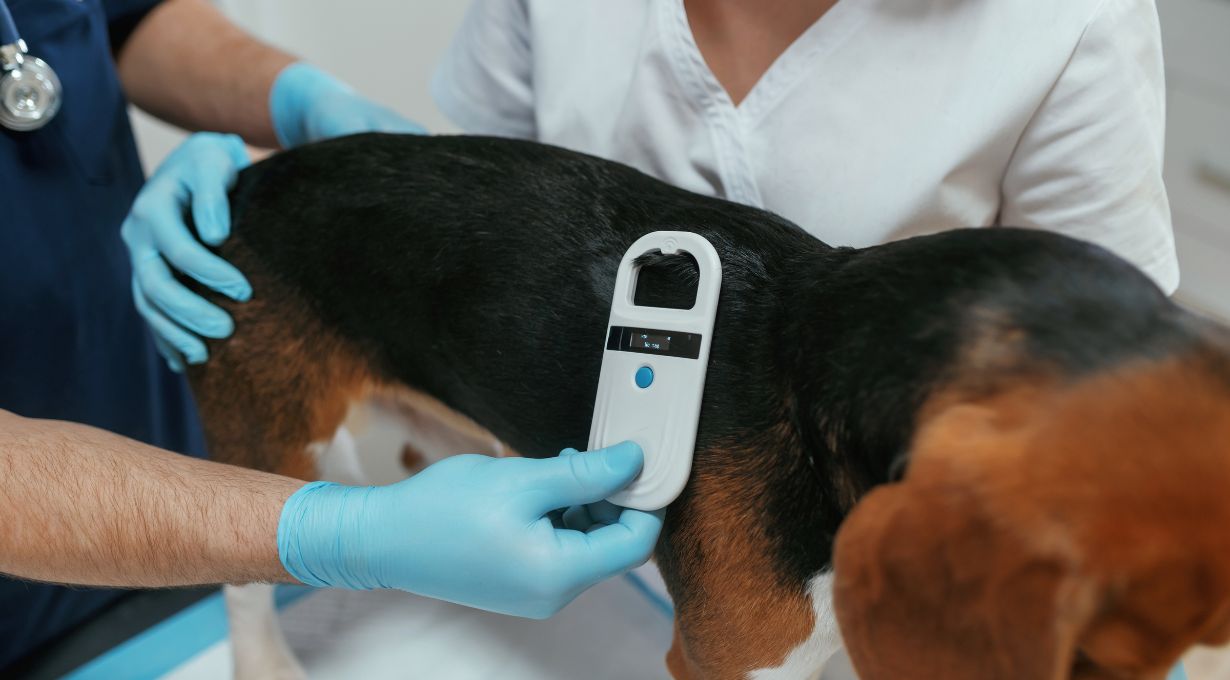
A microchip is a biocompatible capsule about the size of a grain of rice, inserted under the skin between the animal's shoulder blades. It operates via passive Radio-Frequency Identification (RFID) technology: it contains no internal battery and emits no continuous radiation.
When a compatible scanner passes nearby, it energizes the chip, which transmits a unique 15-digit numeric code compliant with international ISO standards 11784 and 11785. This number allows staff at veterinary hospitals, shelters, and animal control services to search national registries and contact the owner.
Is microchipping mandatory in Montreal and Quebec?
While there is no blanket provincial law mandating microchips across all of Quebec, individual municipalities enforce their own animal control bylaws:
- In Montreal: Microchipping is strictly mandatory for all cats, dogs, and rabbits six months of age and older. Proof of implantation is required to purchase or renew the annual municipal pet license;
- Medical exemptions: Only a licensed veterinarian can issue a temporary or permanent exemption if the pet's underlying health condition medically contraindicates the procedure;
- Other municipalities: Check with your local city administration, as numerous municipalities are adopting similar mandates to curb abandonment and reduce animal shelter overcrowding.
How is microchip implantation performed at the vet?
The procedure is simple, safe, and takes only a few seconds. The veterinarian uses a sterile needle applicator to deposit the chip into the dorsal subcutaneous tissue, requiring neither general anesthesia nor sedation.
The brief discomfort experienced is comparable to a routine vaccination injection. In young pets, implantation is frequently performed during spay or neuter surgery (ovariohysterectomy or castration), taking advantage of general anesthesia for an entirely stress-free placement.
How does registration work in Canadian registries?
Physical implantation and database registration are two separate, equally crucial steps. There is no single master registry administered by the Canadian government:
| Step | Responsible party | Objective |
| 1. Microchip implantation | Veterinary clinical team | Sterile subcutaneous insertion and immediate post-implant scanner verification. |
| 2. Initial registration | Clinic or pet owner | Enrolling your contact information in the registry associated with the chip brand (e.g., EIDAP). |
| 3. Future record updates | Pet owner | Mandatory updating of home address and phone numbers following any personal change. |
An unregistered microchip or one tied to outdated contact info prevents rescue shelters from reaching you, leaving your pet classified as an unclaimed stray.
Microchip, ID tag, or GPS tracker: what are the differences?
Each identification method serves a distinct, complementary purpose:
- Subcutaneous microchip: A permanent, tamper-proof proof of identity that cannot be lost, broken, or stripped away if the collar breaks off;
- Collar ID tag: The frontline defense allowing a helpful neighbor to contact you by phone immediately without specialized medical scanners;
- GPS tracker: A collar-mounted device delivering real-time location mapping, but dependent on battery life and rendered ineffective if the collar slips off.
What to do if your pet is lost or after an adoption?
If your pet goes missing, contact their microchip registry immediately to flag them as lost and verify that your phone numbers are accurate. Simultaneously report the disappearance to the Montreal SPCA, local municipal animal control officers, and area veterinary hospitals.
When adopting a pet that is already microchipped, request the official registration certificate immediately to complete the legal change of ownership with the database, ensuring the prior owner or rescue organization is no longer listed as the primary contact.
Key takeaways
- A microchip is a permanent electronic ID card, not an active GPS tracking system.
- Microchipping is legally required for dogs and cats over six months of age within the City of Montreal.
- Microchip efficacy depends on diligent enrollment and continuous updates of your contact details in the designated registry.
- The implantation procedure is fast, minimally uncomfortable, and easily performed during a routine checkup or spay/neuter surgery.
- Pairing a subcutaneous microchip with an external collar ID tag provides the most complete protection for recovering a lost pet.
Microchipping your pet at Velvet
At Velvet, we perform safe microchip implantations using internationally recognized ISO-standard transponders for your dog or cat. During your visit, our team verifies that no prior chip exists, confirms transponder functionality with a digital scanner, and logs the identification number into your pet's medical record.
We supply the official documentation required to purchase your Montreal municipal pet license and guide you through the online registry enrollment process to ensure comprehensive traceability if your companion ever wanders away.
References
- Ville de Montréal – Municipal by-laws on pet licensing, sterilization, and microchipping.
- Ordre des médecins vétérinaires du Québec (OMVQ) – Permanent microchip identification: medical role and public protection.
- Association canadienne des médecins vétérinaires (ACMV) – National companion animal microchipping standards.
- SPCA de Montréal – Resources and identification procedures for locating a lost pet.
- EIDAP Animal Identification Systems – Search and database management for ISO companion animal transponders in Canada.